











The EU's New Packaging Rules Are Here. Here's What You Need to Know.
If you sell into the EU, or you're thinking about it, this one's for you.
- Europe's most significant packaging regulation in 30 years is now in effect — and if you sell into the EU, it affects you regardless of where you're based
- Non-compliance isn't just a regulatory risk; it means packaging cannot legally enter the EU market
- This is our plain-language guide to the regulation, our products' compliance position, and what you need to have in place as a brand
Europe has a new rulebook for packaging, and it applies to everyone — including brands based outside the EU who ship products into European markets. The Packaging and Packaging Waste Regulation (PPWR), formally Regulation (EU) 2025/40, came into force in February 2025 and replaces the old Packaging Directive that had governed EU packaging since 1994.
Unlike a directive, which each Member State could interpret and implement in its own way, the PPWR is a regulation — meaning it applies directly and uniformly across all 27 EU countries from day one. No national variation, no waiting for local governments to catch up. The same rules apply whether your customer is in Berlin, Barcelona, or Bratislava.
We've spent a significant amount of time working through what the PPWR means for our products and for our customers. In this article we share what we've learned ... in plain language!
What the PPWR is actually trying to do
The PPWR has four headline goals:
- Reduce packaging waste
- Increase recyclability
- Mandate recycled content
- Eliminate hazardous substances from packaging
It does this through a combination of hard bans, phased targets, documentation requirements, and extended producer responsibility (EPR) — a framework that holds brands financially responsible for the packaging they put on the market.
The regulation covers all packaging placed on the EU market, regardless of where it was manufactured. If your packaging ends up in the EU, PPWR applies to it.
The key requirements — and when they kick in
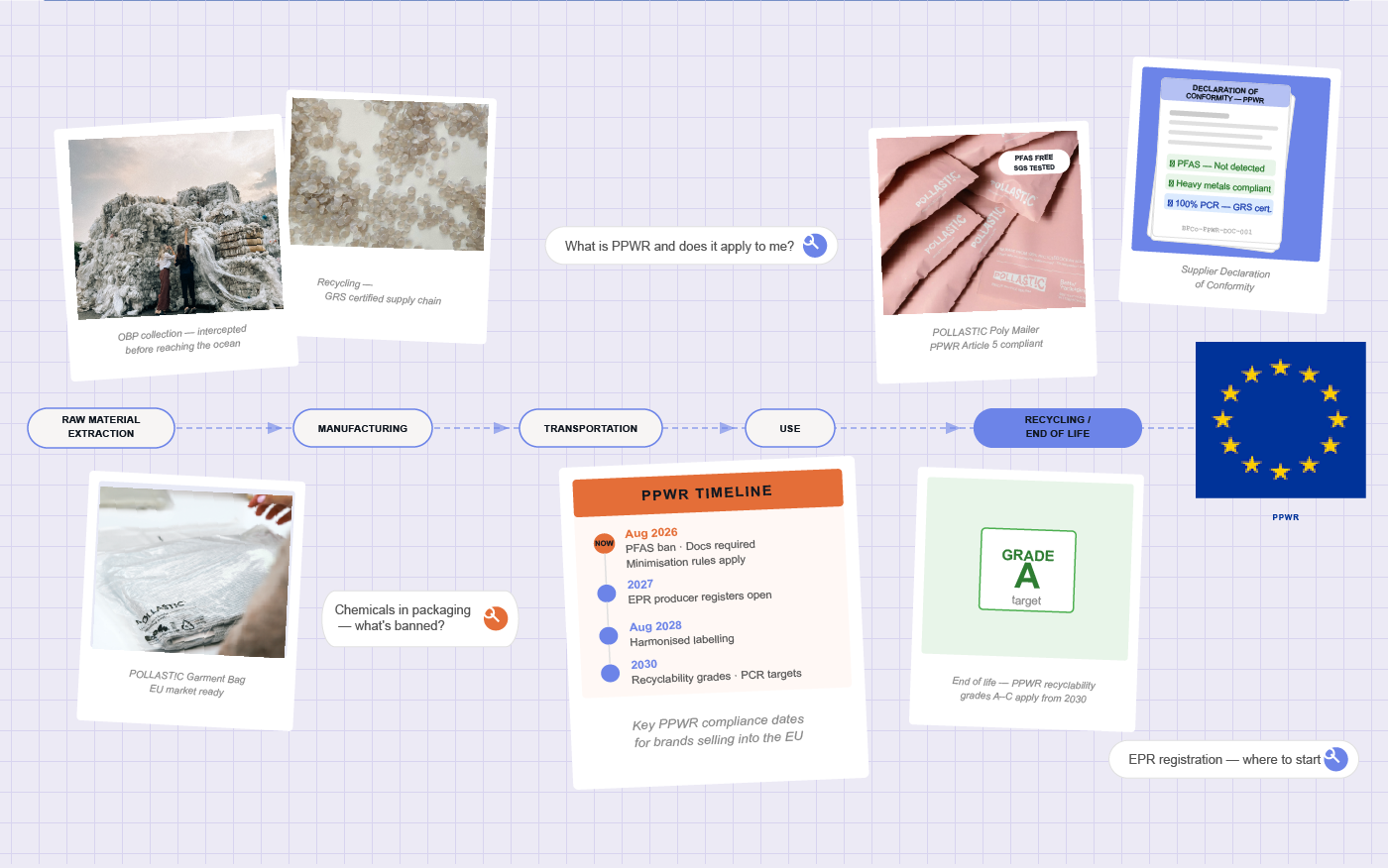
The PPWR phases its requirements in over several years. Here's the timeline that matters:
2026, August — now in effect
The first wave of requirements has already arrived. From 12 August 2026:
-
PFAS are banned in food-contact packaging. Per- and polyfluoroalkyl substances — the 'forever chemicals' widely used in grease-resistant coatings for food packaging — are prohibited above specified concentration thresholds. There is no grace period and no stock exhaustion allowance. If it's on the EU market after 12 August 2026, it needs to comply.
-
Heavy metal limits apply to all packaging. Lead, cadmium, mercury, and hexavalent chromium combined must not exceed 100 mg/kg across all packaging types — not just food-contact.
-
Documentation is mandatory. Every packaging type placed on the EU market must be accompanied by a Declaration of Conformity confirming compliance with the regulation. This must be supported by technical documentation, retained for five years.
2027 — producer registers operational
National producer registers must be up and running across all EU Member States. Brands selling into the EU will need to be registered in each country they sell into.
2028, August — harmonised labelling
Packaging must carry harmonised labels indicating material type, recyclability, and disposal instructions. The days of confusing or inconsistent recycling symbols across different European markets will officially be over.
2030 — recyclability and recycled content targets
From 1 January 2030, all packaging placed on the EU market must be recyclable. The PPWR introduces a grading system — A, B, and C — based on the percentage of the packaging that can be recovered and recycled at scale. Grade C (≥70% recyclable by weight) is the minimum from 2030; grades D and E will be banned.
Mandatory recycled content targets for plastic packaging also kick in from 2030, requiring plastic packaging to contain a minimum percentage of post-consumer recycled (PCR) material.
Packaging minimisation rules will apply. Ecommerce packaging must not exceed 50% empty space. No unnecessary void fill, no oversized boxes for small products.
2038 — grades D and E phased out further
Only grade A (≥90%) and grade B (≥80%) packaging will be permitted.
What this means for brands selling into the EU
Under PPWR, the legal compliance obligations sit with the producer — the party placing the packaging into the EU market. For most of our customers, that's you, not us.
In practical terms, if you're using Better Packaging products to ship goods to EU customers, here's what you're responsible for:
Register as a producer. You'll need to register in each EU Member State where you place packaged goods on the market. National producer registers must be operational by 2027, but the sooner you understand which countries you're selling into, the better.
Enrol in EPR schemes. Extended Producer Responsibility means you're financially responsible for the end-of-life management of the packaging you put on the market. You'll need to enrol in EPR schemes in each relevant Member State and pay fees that fund packaging waste collection and recycling infrastructure. Fees are proportional to the volume and type of packaging you use.
Issue a Declaration of Conformity. For every packaging type you place on the EU market, you need a Declaration of Conformity — a legally binding document confirming compliance with PPWR Articles 5 through 12. You can't issue this document without supplier data. Which brings us to what we do.
Meet the minimisation requirements. If you're using our mailers for eCommerce fulfilment, ensure you're using appropriate sizing. The 40% empty space maximum is already in effect.
Plan for labelling. If you're printing your own labels or purchasing packaging with specific labelling, harmonised EU labelling requirements come into force in August 2028. It's worth factoring this into any packaging redesign conversations you're having now.
One important nuance: if your business qualifies as a micro-enterprise under the EU definition (fewer than 10 employees and annual turnover of €2 million or less), producer obligations may transfer to your non-EU packaging supplier. If this applies to you, we'd recommend seeking legal advice on how this affects your specific situation.
What we're doing — and what we can provide
Our job is to make sure the packaging we supply you is technically capable of meeting PPWR's requirements, and to give you the documentation you need to support your own compliance.
Here's where our key product lines currently stand:
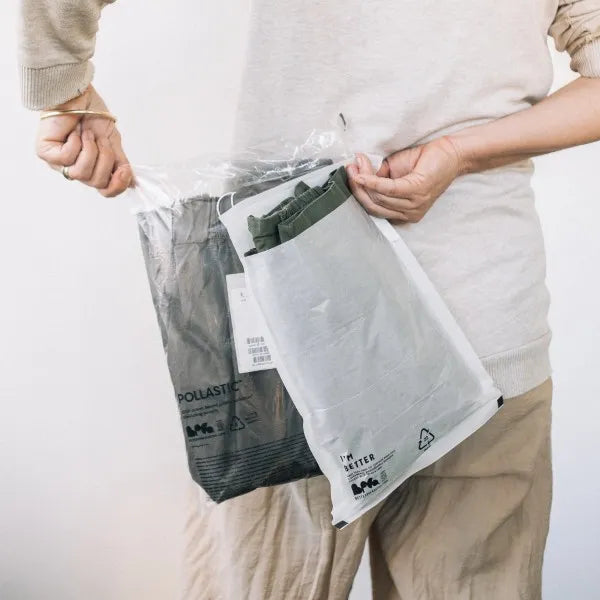
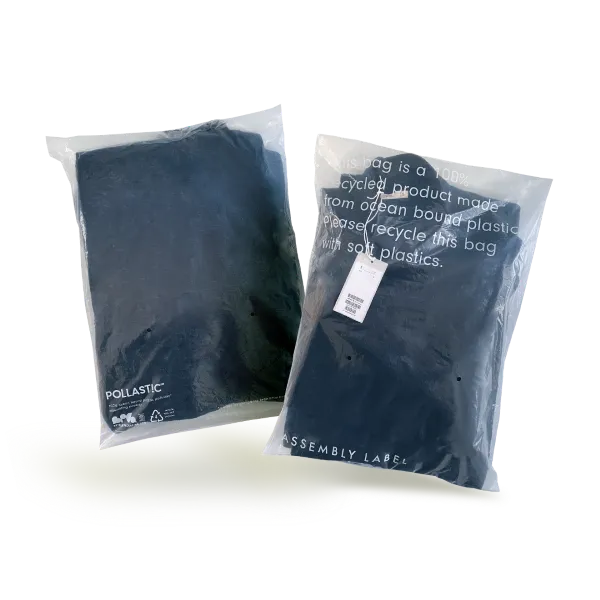
POLLAST!C — our 100% Recycled Ocean Bound Plastic range — is our strongest position for the EU market. POLLAST!C is already well ahead of the mandatory recycled content targets that don't come into force until 2030. We hold SGS laboratory test results confirming no PFAS detected across our POLLAST!C poly mailer and poly garment bag ranges, and our 100% post-consumer recycled (PCR) content is independently verified by the Global Recycled Standard (GRS). We have issued a formal Supplier Declaration of Conformity for POLLAST!C — available to customers on request — covering substance restrictions under Article 5 and our recycled content position under Article 7.
For recyclability grades under Article 6, the technical criteria won't be finalised until the PPWR delegated acts are published in 2028. We're monitoring this closely and will update our documentation as the framework develops. What we can say now is that mono-material HDPE/LLDPE formats — which is what POLLAST!C is — are well positioned within EU recycling infrastructure, and we'll be pursuing formal RecyClass assessment as the criteria are confirmed.
Our bamboo fibre packaging is also a promising option for the EU market. Bamboo fibre sits within the fibre-based packaging category — Europe's highest-recycling material stream. We hold repulpability test results from GRS demonstrating recyclability, and we're currently working to have this testing validated against the EU's 4evergreen Recyclability Evaluation Protocol. We'll update customers when that work is complete.
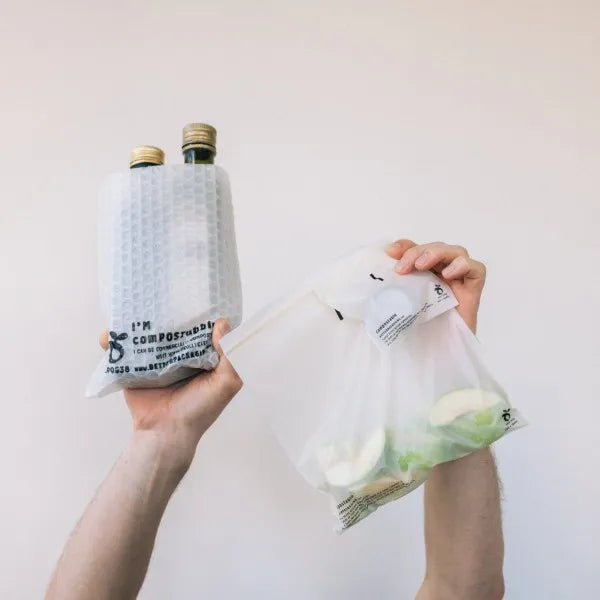
Our compostable range is not currently recommended for the EU market. Under PPWR, compostable packaging is only permitted in very specific applications — tea bags, fruit stickers, and lightweight carrier bags. Mailing and e-commerce packaging is not included in that list, and no harmonised EU home compostability standard currently exists. This is an area we're watching closely as the regulation evolves, but we want to be straight with you about the current position.
Our 0PACK stone paper range — made from 90% calcium carbonate and 10% HDPE — does not currently have a recognised end-of-life pathway in EU recycling infrastructure. This is a materials science challenge that the industry is working on, and we continue to invest in finding solutions. In the meantime, 0PACKs' genuine sustainability story remains its production side: no trees, no water, no bleach, and a significantly lower carbon manufacturing footprint. These are real and communicable benefits. We just can't make an EU recyclability claim for them right now, and we won't.
The documentation you need from us — and what to do with it
Under PPWR, your Declaration of Conformity must be supported by technical documentation from your packaging supplier. An informal statement that packaging is "PFAS-free" or "recyclable" is not sufficient — you need accredited test results and certification documentation.
For POLLAST!C packaging, we can provide:
- Our Supplier Declaration of Conformity (document reference BPCo-PPWR-DOC-001), confirming compliance with PPWR substance restrictions under Article 5
- SGS laboratory test results confirming no PFAS detected
- GRS certification confirming 100% post-consumer recycled content
-
Zero Plastic Oceans certification confirming Ocean Bound Plastic source material
- SGS laboratory test results confirming heavy metal restrictions are met
You use these documents as the evidential foundation for your own Declaration of Conformity, which you then issue and retain for five years.
If you're a customer asking us for documentation, reach out to your account manager or contact us at sales@betterpackaging.com. We're committed to turning requests around promptly — we know compliance timelines don't move for anyone.
A note
We think the PPWR is a good thing. Packaging that is genuinely recyclable, made from recycled content, and free of harmful substances is exactly what we've been trying to make since we started Better Packaging Co. in 2018. The regulation raises the floor for the whole industry, and that matters.
But we also think the most useful thing we can do for our customers right now is tell the truth about where our products stand — including where the regulatory picture is still evolving, where we have gaps to close, and where we're still waiting on the EU to finalise the rules we need to comply with. There's enough vague "PPWR-ready" marketing out there already. We'd rather give you something you can actually use.
If you have questions about your specific products or compliance situation, we're happy to talk it through. This is new territory for everyone.
Further reading
Regulation (EU) 2025/40 — the regulation itself The authoritative source. Dense, but Section 1 (Articles 1 to 15) covers the core requirements most relevant to brands and their suppliers.
European Commission — PPWR overview The Commission's own summary page, updated as delegated acts and guidance documents are published.
RecyClass — plastic packaging recyclability The EU's primary recyclability assessment and certification body for plastic packaging. Includes material-specific guidelines and a searchable database of assessed packaging formats — useful for understanding where your packaging sits before pursuing formal assessment.
4evergreen — fibre-based packaging recyclability The equivalent body for paper, board, and other fibre-based packaging. The 4evergreen Recyclability Evaluation Protocol is the working standard against which bamboo fibre and other non-wood fibre packaging is assessed.
EXPRA — Extended Producer Responsibility Alliance The European industry body representing national EPR schemes. The best starting point for understanding how EPR registration and fee obligations work country by country.
ECHA — PFAS restrictions The European Chemicals Agency's definitive resource on PFAS restrictions across EU legislation, including the PPWR thresholds for food-contact packaging.
Better Packaging Co. is a sustainable packaging company founded in 2018. We manufacture packaging from recycled and lower-impact materials and supply brands in Australia, New Zealand, the United States, and globally. This article is informational and does not constitute legal advice. We recommend seeking independent legal counsel for your specific PPWR compliance obligations.
Last updated: August 2026